For more than a decade, the Cambodian rice industry has been chasing a single number. One million tonnes of milled rice exported in a single year. It was a goal first set in 2010, written into every plan and every speech since.
This year, the country will reach it.
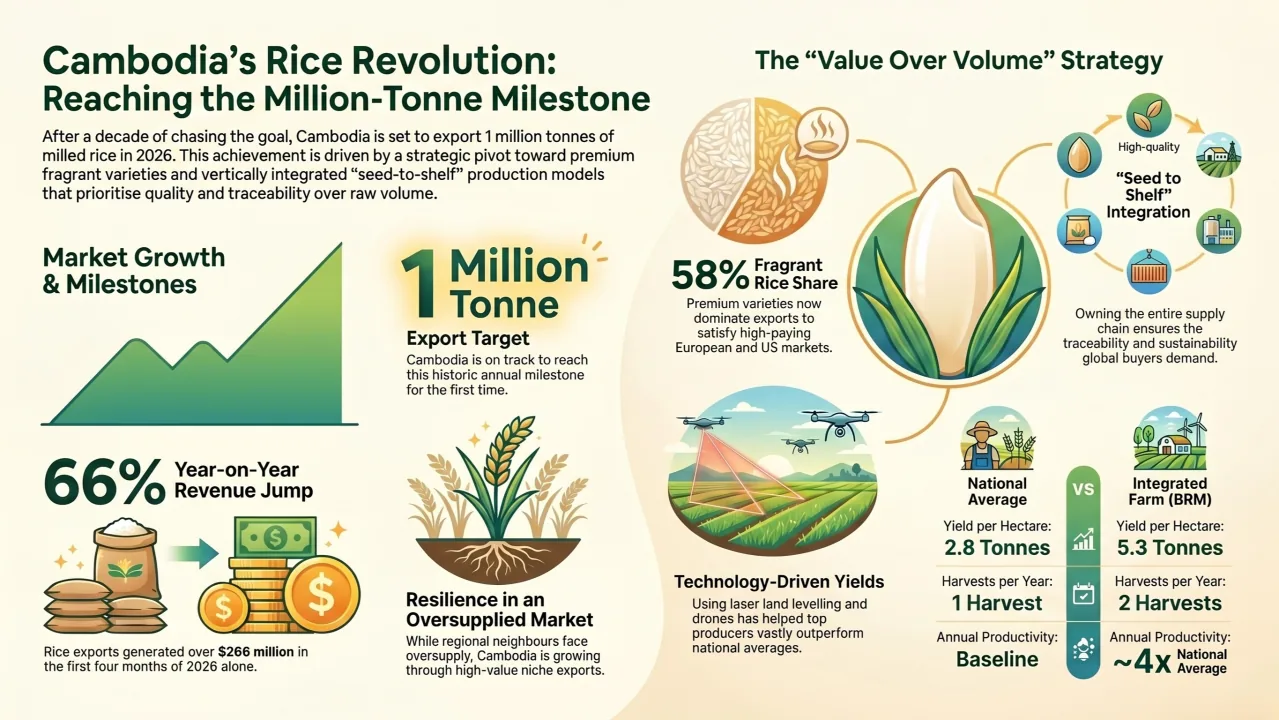
In the first four months of 2026 alone, Cambodia shipped close to 470,000 tonnes of milled rice to sixty markets, generating more than 266 million dollars in revenue. That is a 66 percent jump over the same period last year. The Cambodia Rice Federation has confirmed what most of us in the industry have been feeling for months. Something is shifting.
Across the rest of the region, the picture looks different. India is preparing to ship roughly 25 million tonnes over 2025 and 2026, enough to weigh on global prices on its own. Indonesia has effectively stopped importing. The Philippines is buying less rice than it has in years. Most rice-producing countries are bracing for an oversupplied market. Cambodia, somehow, is growing into it.
The reason is not luck. As Oknha Lay Chhun Hour, the president of the Cambodia Rice Federation, recently put it, Cambodia is moving away from a \"volume at all costs\" model toward a value-driven strategy. The data backs him. Fragrant rice now accounts for more than 58 percent of national exports. The premium grades that European buyers pay extra for, the Malys Angkor, SKO, SRO, and Jasmine varieties, are the ones doing the work.
This is the strategy we built BRM Agro around from the start.
Why we chose to own the whole chain
When we set up in Kampong Thom, we made a decision that was unusual for the Cambodian rice industry then, and is still unusual now. We decided to own the land, work directly with farmers, run our own mill, and manage the relationships with our buyers ourselves. Seed to shelf. Every step.
The reasoning was simple. If you want to sell Cambodian rice as a premium product in Europe, the United States, and the Middle East, you cannot afford uncertainty at any point along the chain. Buyers in those markets ask hard questions about traceability. About sustainability. About what is actually in the bag. The only way to answer those questions honestly is to be on the ground at every stage.
Today, we farm more than 2,000 hectares of freehold land in Kampong Thom, work alongside the farmers in our network, and operate a modern mill in Santuk District producing 3,000 tonnes a month. We are now midway through a capacity expansion that will take the mill to 150,000 tonnes a year. When it is done, BRM will be Cambodia's largest vertically integrated premium rice exporter operating at international scale.
But scale has never been the point. The point has always been to prove that Cambodian rice belongs at the top of the global market, alongside the world's most respected origins.
The farmers are the story
The farms in our network produce around 5.3 tonnes of rice per hectare per harvest, across two harvests a year. The Cambodian national average is closer to 2.8 tonnes per hectare on a single harvest. Roughly four times the annual yield, from the same soil.
Some of that gap is technology. Laser land leveling. Alternate wetting and drying, which uses less water without losing yield. Drone fertilization. Biochar. The bio-fertilizers we produce in-house. None of it is exotic. All of it works.
But technology alone does not close the gap. The relationships do. Most of the farmers working with us have been part of the BRM network for years. We do not approach them as suppliers. We approach them as partners. The household benefits, the single-mother support, the childcare, the education programs, the technical teams in the field, all of it comes from the same belief. If we want farmers to invest in better practices, we have to invest in them first.
That model is now drawing in more growers. Over a thousand farmers in the surrounding districts have asked to join. We are scaling carefully, because trust is harder to build than capacity.
The headwinds we are not ignoring
None of us in the industry is taking the current moment for granted. Freight costs are rising because of the situation in the Middle East. Fertilizer is more expensive. Insurance is up. Cambodia's export prices are expected to rise five to ten percent over the next three months on logistics alone. Paddy prices fell earlier this year, and the government has had to step in with emergency financing for farmers and millers. El Niño is still in the long-range forecast.
These are real pressures. They are also cyclical. The structure underneath is what matters, and the structure is good. Cambodia has spent fifteen years building the foundations of a premium rice industry. The country is finally being recognized for what it produces, not just for how much.
What comes after the milestone
A million tonnes is a milestone for the country. The next chapter is about what kind of industry we want to be once we cross it.
Our answer at BRM is the one we have been building toward since day one. A Cambodian rice industry that competes on quality, traceability, and sustainability. An industry that pays its farmers properly. An industry that earns its place on European shelves and American tables on merit, not on price.
We are grateful to the farmers, the team, our partners, and the buyers building it with us. The harvest this year was a good one. The work continues.